RCD types explained: AC, A, F and B
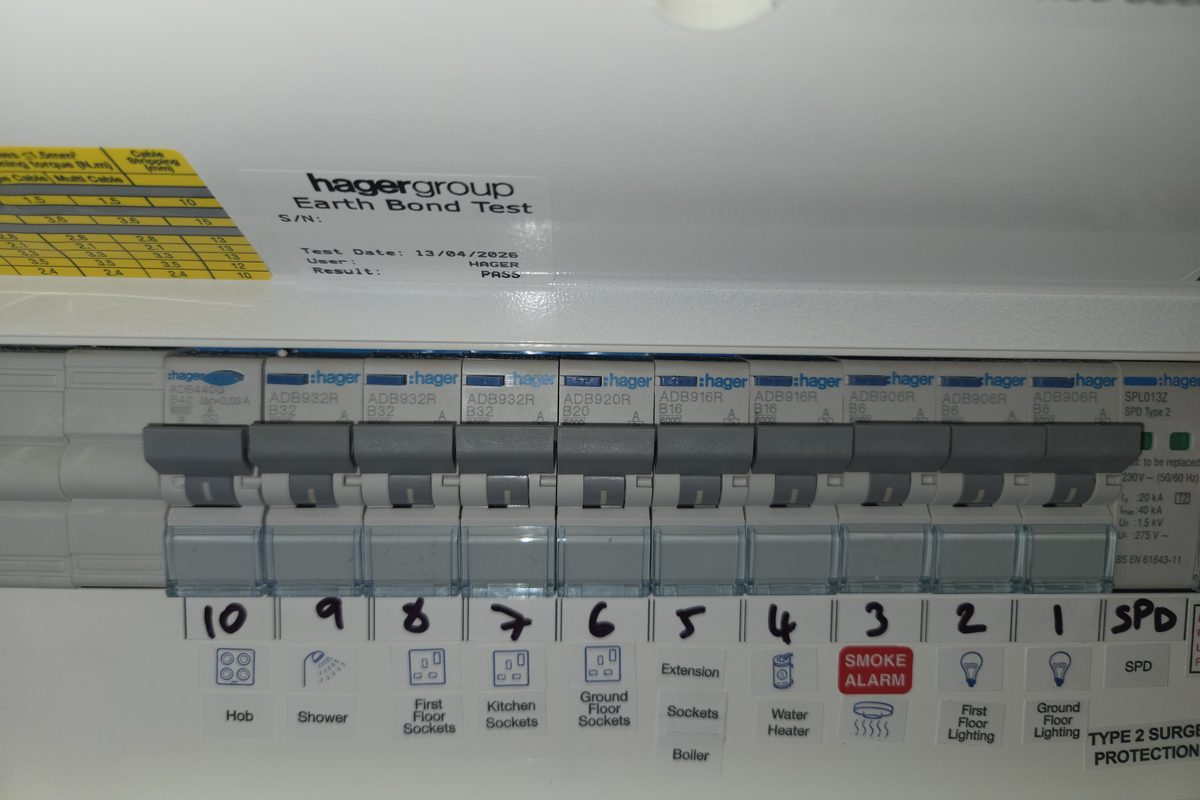
An RCD is the device that cuts the power when current starts going somewhere it should not, usually through a person. Most people know that much. What almost nobody knows is that they come in types, that the type matters enormously, and that the type fitted in a great many British homes was chosen for a world with far less electronics in it.
This is the least glamorous thing on this website and one of the most consequential.
The four types, in plain terms
You will meet four. Roughly in order of what they can detect:
- Type AC detects clean alternating fault current. The basic one, fitted almost everywhere for decades.
- Type A detects everything Type AC does, plus pulsating direct-current fault content.
- Type F detects everything Type A does, plus the mixed-frequency content that variable-speed motors produce. Think washing machines and some heat pumps.
- Type B detects the full set, including smooth direct current.
They are not interchangeable, and a device further down that list is not simply a nicer version of the one above it. Each one sees a wider range of fault than the last.
Why Type AC stopped being enough
Not because the device got worse. Because what you plug into it changed.
A Type AC RCD is looking for a clean alternating waveform. That is what a fault on a 1985 installation looked like, because almost everything on the circuit was a motor, a heater or a filament lamp.
Then everything acquired a power supply inside it. LED drivers, laptop chargers, inverters, variable-speed motors, solar arrays, car chargers. All of those convert the incoming mains into direct current internally, and a fault downstream of that conversion does not look like a clean alternating waveform any more.
A Type AC device looking at that kind of fault can fail to see it. Worse, a small amount of smooth direct-current leakage passing through a Type AC can affect the device's ability to detect anything at all, including the ordinary faults it was designed for. It sits in the board looking exactly like protection.
That last point is the one worth carrying away. The failure is quiet. Nothing trips, nothing buzzes, nothing looks wrong.
Where this actually bites, in real houses
This is not theoretical. I write it up on condition reports.
Car chargers. The most common case by a distance. A charger added to a circuit protected by an existing Type AC device, sometimes because the board was never opened during the install.
Solar and battery installations. Inverters produce exactly the fault characteristics a Type AC struggles with. There are two real examples in the What I Found series, both on the same property, both solar: a unidirectional device fitted the wrong way round on a generating circuit, and a separated protective conductor.
Heat pumps. Variable-speed compressors, which is the Type F case.
Induction hobs and modern kitchens. Less dramatic, more common than people expect.
The find that matches this post most directly is What I Found 004: a Type AC device protecting modern loads.
How to find out what you have
Open your consumer unit and look at the front of the device. The type is printed on it, usually as a small symbol next to the current rating rather than a letter.
- A sine wave symbol on its own is Type AC.
- A sine wave plus a half-wave shape is Type A.
- F and B are usually marked as letters.
If there is no marking you can see at all, it is old, and old means Type AC in practice.
Take a photo and send it to me if you are unsure. That is a thirty-second answer, not a call-out. While you have the board open, how many circuits has your house got covers what everything else in there is doing, and it is the number that prices an inspection.
What to do about it
If you have no RCD protection at all, which is normal in a board from before roughly the mid-1990s, that is the finding that matters, not the type. See consumer unit upgrades.
If you have Type AC and you are adding a car charger, solar, a battery or a heat pump, the protection gets addressed as part of that job. It is not an upsell, it is part of doing the work correctly, and a decent installer will raise it before you ask. See EV charger installation.
If you have Type AC and you are not adding anything, it goes on an EICR with a code, and the code tells you how urgent it is. It is very rarely an emergency. See what an EICR costs in York for the price.
What I fit. Every consumer unit upgrade I do gets an individual device on every circuit, so a fault on one circuit takes out one circuit rather than half the house, and the type is selected for what that circuit actually feeds.
Questions
Is my Type AC RCD dangerous?
On its own, no. In combination with the wrong load it can be protection that is not protecting, which is why it gets written up rather than ignored. The judgement is about what is connected to it, not the device in isolation.
Can I just swap the RCD for a better type?
Sometimes. It depends on the board, whether a compatible device is still made for it, and whether the rest of the installation justifies it. That is a look, not a phone answer.
What is the difference between an RCD and an RCBO?
An RCD detects current leaking to earth; an RCBO combines that with overload protection in one device per circuit. RCD vs RCBO covers it properly, and MCBs, RCDs and RCBOs explained covers the whole family.
Why did my last electrician not mention it?
On an older report it may not have been the expectation at the time. On a recent one it should have been raised. A second opinion is an option if you want another set of eyes on it.
Not sure what is in your board?
Send me a photo of the front of your consumer unit and I will tell you what you have got. No charge for that, and no obligation attached to it.