How many circuits has your house got?
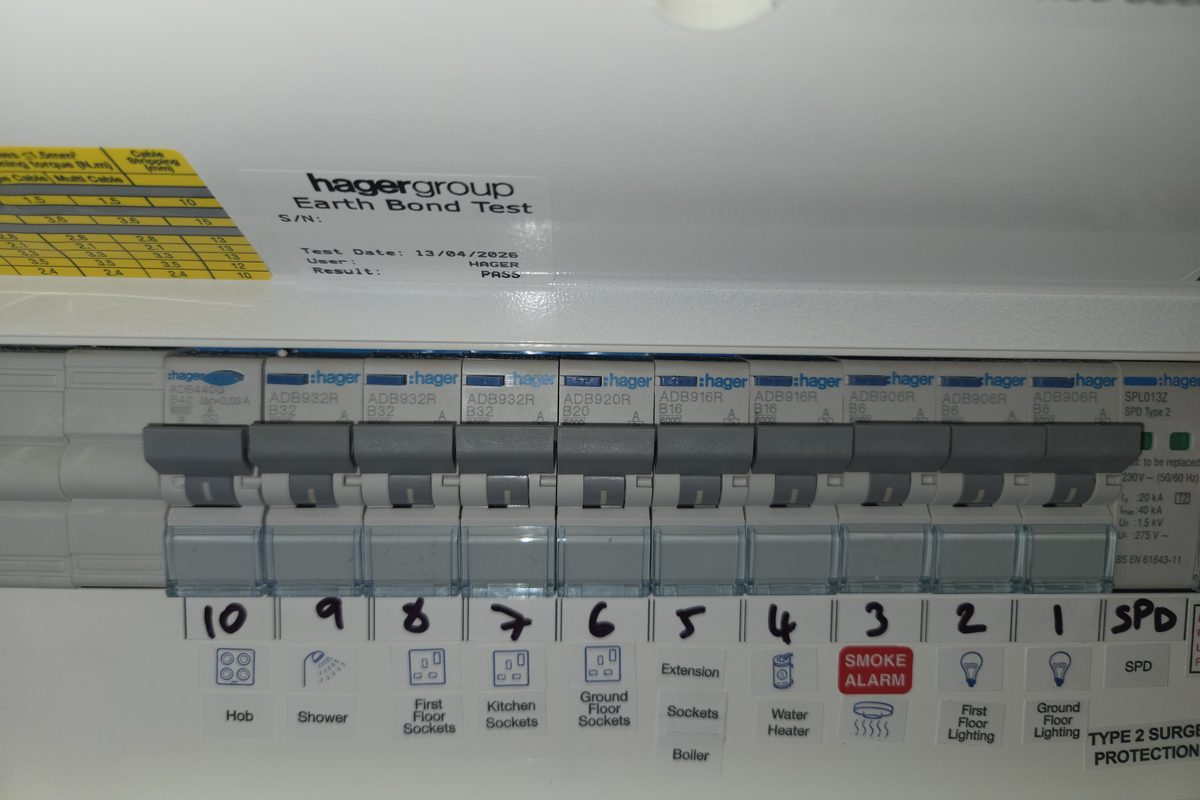
It is one of the first things I ask when somebody rings me, and most people have never been asked it before. You do not need to touch anything to answer it, and you do not need to know what any of the switches do. You only need to count them properly, and counting them properly is not the same as counting what is in the box.
So this piece is about doing that yourself. What a circuit actually is, how to count the ones you have got, and what the writing next to each switch is telling you.
What counts as a circuit
A circuit is one route out of the consumer unit. A cable leaves the board, goes and feeds something, and comes back. The upstairs lights are a circuit. The kitchen sockets are a circuit. An electric shower has a circuit to itself. Each one has its own protective device sitting in the board, and that device is the switch you see when you lift the cover.
Two things in the board are not circuits, and both of them get counted by mistake. The main switch, the one that turns the whole lot off, feeds the board rather than a circuit. And in an older split-load board an RCD sits at the head of a group, protecting the circuits behind it without feeding anything itself. If you want to know which device is which while you are stood looking at the row, I have gone through them in RCD vs RCBO, and across the wider set in MCBs, RCDs, RCBOs and AFDDs explained.
The range I have actually measured
Across the York homes where I have opened up and tested the board, the circuit count has come out between 4 and 12. That is why I price an EICR on circuits rather than bedrooms: the number of bedrooms tells you very little about what is actually in the consumer unit.
That is one range covering every kind of home, and I have left it that way on purpose. I am not going to split it into a figure for this sort of house and a figure for that sort, because I would be guessing at the split, and a guess with my name on it is worse to you than no number at all. The range above is not a guess. It is what I have found in the boards.
The reasoning behind pricing this way rather than by the size of the house is set out in full in why I price EICRs by circuits, not bedrooms.
How to count yours
You are only looking. Nothing needs switching off, and nothing needs opening beyond the flap on the front.
- Find the consumer unit. Under the stairs, in a hallway cupboard, in the garage, or near the front door in a flat. It is the box with a row of switches in it.
- Leave the main switch out of the count. It normally sits at one end of the row, it is often a different size to the rest, and it is frequently red.
- Leave any RCDs out of the count. In a split-load board these are the wider devices carrying a small test button, each one heading up a group.
- Count what is left. Count the switches in your consumer unit that actually feed something, not the number of spaces in it. Boards are usually fitted with room to spare, and every one I have tested has had between one and three empty or blanked-off ways.
- If you have fuses rather than switches, count the fuse carriers instead. That means you are looking at a fuse box rather than a consumer unit, and fuse box or consumer unit is worth a read before you decide anything else.
Take a photo of the open board while you are stood there. It is quicker than writing it down, and if you send it over I will tell you what you are looking at.
What the labels mean
Most boards carry some writing next to each switch, either printed on a strip or put on by hand. Here is what the common ones are telling you.
| Label | What it feeds |
|---|---|
| Lights upstairs, Lights downstairs | The ceiling fittings and wall switches on that floor. One circuit each. |
| Sockets upstairs, Sockets downstairs | The socket outlets on that floor. |
| Kitchen | The kitchen sockets, where they have been separated out from the rest of the house. |
| Cooker | An electric oven or hob wired into the wall rather than plugged in. |
| Shower | An electric shower, which has a circuit to itself. |
| Immersion | The electric heating element in a hot water cylinder. |
| Boiler | The supply to the boiler and its controls. |
| Smokes, Alarms | Mains-powered, linked smoke and heat detection. |
| Garage, Shed, Outside | Power taken outside the house, either as a circuit of its own or as a sub-main feeding a small board out there. |
| EV, Charger | A car charger. |
| PV, Generation | A solar array feeding back into the board. |
If you see a label you do not recognise, or a switch with nothing written next to it at all, make a note of it. An unlabelled switch is a circuit nobody has recorded, and where it goes is worth establishing before anyone works on the board.
The ones that are easy to miss
Not everything announces itself as an obvious labelled switch. These are the ones worth a second look:
- An outside socket fed from a spur off another circuit rather than from its own way in the board
- A garage or a shed on a sub-main, with its own small board at the far end of it
- An old storage heater circuit that has been disconnected but left wired in
- A garden office or a summerhouse on a supply of its own
- A doorbell transformer sitting inside the consumer unit, which is not a circuit
- On a property with solar, a generation circuit, and sometimes a battery circuit alongside it
If you want to see the sort of thing that turns up once a board is opened up and tested, the What I Found series is a running log of it.
Not sure what you are looking at?
Send me a photo of the inside of your consumer unit. I will count the circuits for you and tell you what each one is. No charge, no obligation.
Frequently asked questions
How many circuits does a house have?
Across the York homes where I have opened up and tested the board, the circuit count has come out between 4 and 12. That is why I price an EICR on circuits rather than bedrooms: the number of bedrooms tells you very little about what is actually in the consumer unit.
Is the number of switches in my consumer unit the same as the number of circuits?
Not quite. Count the switches in your consumer unit that actually feed something, not the number of spaces in it. Boards are usually fitted with room to spare, and every one I have tested has had between one and three empty or blanked-off ways. The main switch is not a circuit either, and neither is an RCD sitting at the head of a group in an older split-load board.
My consumer unit only has four switches. Is that normal?
Four is the bottom of the range I have measured in York homes, so it is a real count rather than a mistake in your counting. A low number on its own does not tell you whether the installation is in good order. That is what an EICR is for.
Why do you not price on the number of bedrooms?
Because the number of bedrooms tells you very little about what is actually in the consumer unit. A circuit is something I have to isolate, test and write up. A bedroom is not.
Do I need to count my circuits before I get in touch?
No. If you already have the number it saves a step. If you have not, a photo of the inside of your consumer unit does the same job, and I will tell you what you are looking at.