What your EV charger installation price leaves out
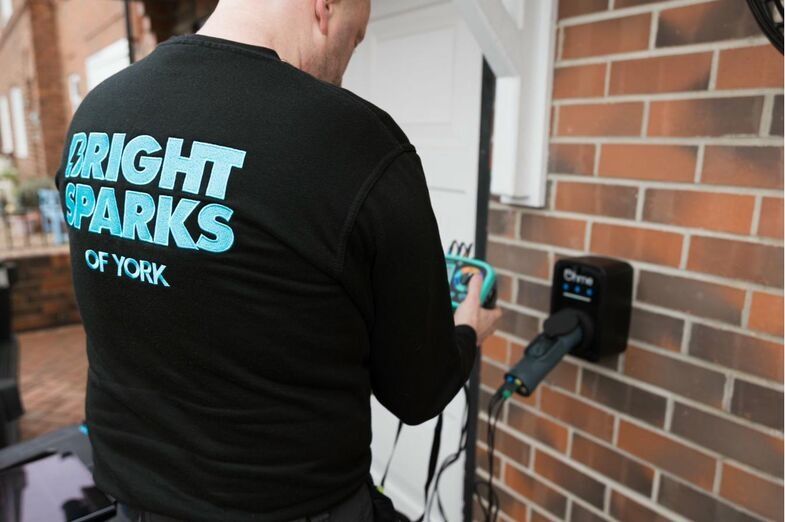
Home charge points are advertised as one fitted price, and for a lot of installations that number is honest enough. What it quietly assumes is a short cable run, a consumer unit with capacity and space in it, an incoming supply that can take the extra load, and nothing unusual anywhere between the three. When one of those assumptions turns out to be wrong, the price moves. It is much better to find out which one before somebody is standing on your drive with a drill in their hand.
Six things decide what a home charge point installation actually costs. Here they are in the order I look at them.
1. The cable run
The single biggest variable, and the one nobody asks about on the phone.
A charge point on the garage wall next to the consumer unit is a short run in trunking, and it is a morning's work. A charge point at the far end of a drive, on the opposite side of the house from the board, means a longer cable, possibly buried armoured cable, possibly a trench, and possibly a route through a wall that is anything but straightforward.
Measure the distance from your consumer unit to where you want the charger, going the way a cable would have to go, not in a straight line. That number changes the price more than the choice of charge point does.
2. What your consumer unit can take
Three separate questions, and they have three separate answers.
Is there a spare way? That is physical space in the board for another device. A full board is not a disaster, but it is a cost, and it needs knowing about before anything is ordered.
Is the protection right? A charge point needs its own 30mA protective device, and it has to be a type that keeps working when the car puts steady direct-current leakage on the circuit. Some chargers include that detection; where they do not, it is a separate device in the board, and it is one of the things a headline charger price often leaves out.
Is the board fit to be worked on at all? If it is a rewireable fuse box, the charge point conversation becomes a consumer unit conversation first. That is not an upsell, it is the order the work has to happen in. There is more on that in consumer unit upgrades in York.
3. Your incoming supply, and load balancing
Your house has a maximum. Adding a charge point to a property that already has an electric shower, an electric oven and possibly a heat pump means somebody has to do the arithmetic properly rather than assuming it will be fine on the day.
Sometimes the answer is load balancing, where the charge point backs off while the rest of the house is drawing heavily. Sometimes the answer is that the supply itself needs attention, which brings in the network operator and turns into a longer conversation.
Either way, that calculation is part of the job and it happens before anything is ordered, not after.
4. Registering it with the network operator
Your charge point has to be registered with the network operator, and whether that happens before or after the work depends on how much your house can already draw. Where the property's maximum demand stays within 60 amps per phase and the other conditions are met, the charge point can be fitted first and the network operator notified within 28 days. Above that, the application goes in first and has to be answered before the work goes ahead, which they aim to do within ten working days for anything up to 100 amps.
In York the network operator is Northern Powergrid, and it follows that same national process.
It is worth asking whoever is pricing the work whether that registration is included, because it is not visible in a headline figure either way.
5. The charge point itself
Cheapest is rarely the useful question. The ones that matter are whether it is tethered or untethered, whether it will match to solar if you have panels or plan to, how the app behaves day to day, and what happens to that app if the manufacturer stops trading in three years.
I will talk you through the units I am confident standing behind, and why, on the survey. EV charger installation in York has the detail on how I work, and the EV charging guide covers the wider picture if you are still deciding.
6. The grant, and whether you qualify
The government grant pays 75% of the cost of buying and installing a charge point, up to £500. The schemes run until 31 March 2027.
Who can claim is where most of the disappointment happens, so here it is plainly:
You can claim if you own the flat you live in, or you rent your home, and you have your own private off-street parking space. The space has to be off-street, private, clearly marked and always available to you, though it does not have to be part of the property. If you own the house you live in and have a driveway, there is no grant for you. If you own your house and have no off-street parking there is a separate scheme, which needs a permanent channel across the pavement rather than a cable mat, and your council's permission. Lodgers cannot claim, and you cannot claim twice.
If you are a residential landlord, the numbers work differently. You can claim 75% up to £500 per socket, for up to 200 sockets a year. Where landlord organisations are under common control, the 200 applies to the group rather than to each company. This is the only landlord grant still open, and if you are fitting charge points across a portfolio it is worth a conversation before you start rather than after. The landlord hub for York is the place to start.
What is in my price
- The survey, and the load calculation that comes out of it
- The dedicated circuit and the protection that circuit needs
- Full testing and certification
- The charge point commissioned and working, with the app set up before I leave
What is not in it, and what I will tell you before I start rather than after: groundworks for a long buried run, a consumer unit that has to be replaced first, and any work on the supply if the calculation says so. Every one of those is findable on a survey. None of them should be a surprise on the day, and on my jobs they are not, because the estimate goes to you in writing before anything is booked in.
The question to ask any installer
Not "how much". Ask this instead:
"What is your price if the cable run is twenty metres and my consumer unit has no spare way?"
An installer who has a clear answer has already surveyed. If the answer is that it will be fine, the survey has not happened yet. It is a fair question to put to anybody, me included.
Frankie Sewell
NICEIC Approved Contractor • YRLA Recognised Service Provider • Bright Sparks of York
Thinking about a charge point in York?
I survey the property, do the load calculation, and put the whole thing in writing before anything is ordered.
Frequently asked questions
How much does the government grant pay towards a home charge point?
The government grant pays 75% of the cost of buying and installing a charge point, up to £500. The schemes run until 31 March 2027.
Can I get the grant if I own my house and have a driveway?
No. If you own the house you live in and have a driveway, there is no grant for you. You can claim if you own the flat you live in, or you rent your home, and you have your own private off-street parking space. The space has to be off-street, private, clearly marked and always available to you, though it does not have to be part of the property. If you own your house and have no off-street parking there is a separate scheme, which needs a permanent channel across the pavement rather than a cable mat, and your council's permission. Lodgers cannot claim, and you cannot claim twice.
How many charge points can a landlord claim the grant for?
Residential landlords can claim 75% up to £500 per socket, for up to 200 sockets a year. Where landlord organisations are under common control, the 200 applies to the group rather than to each company. This is the only landlord grant still open.
Does my EV charger have to be registered with the network operator?
Your charge point has to be registered with the network operator, and whether that happens before or after the work depends on how much your house can already draw. Where the property's maximum demand stays within 60 amps per phase and the other conditions are met, the charge point can be fitted first and the network operator notified within 28 days. Above that, the application goes in first and has to be answered before the work goes ahead, which they aim to do within ten working days for anything up to 100 amps. In York the network operator is Northern Powergrid, and it follows that same national process.
Does an EV charger need its own RCD?
A charge point needs its own 30mA protective device, and it has to be a type that keeps working when the car puts steady direct-current leakage on the circuit. Some chargers include that detection; where they do not, it is a separate device in the board, and it is one of the things a headline charger price often leaves out.
What is the one question to ask an EV charger installer?
Ask what the price is if the cable run is twenty metres and the consumer unit has no spare way. An installer who has a clear answer has already surveyed. If the answer is that it will be fine, the survey has not happened yet. Get in touch to book a survey.